
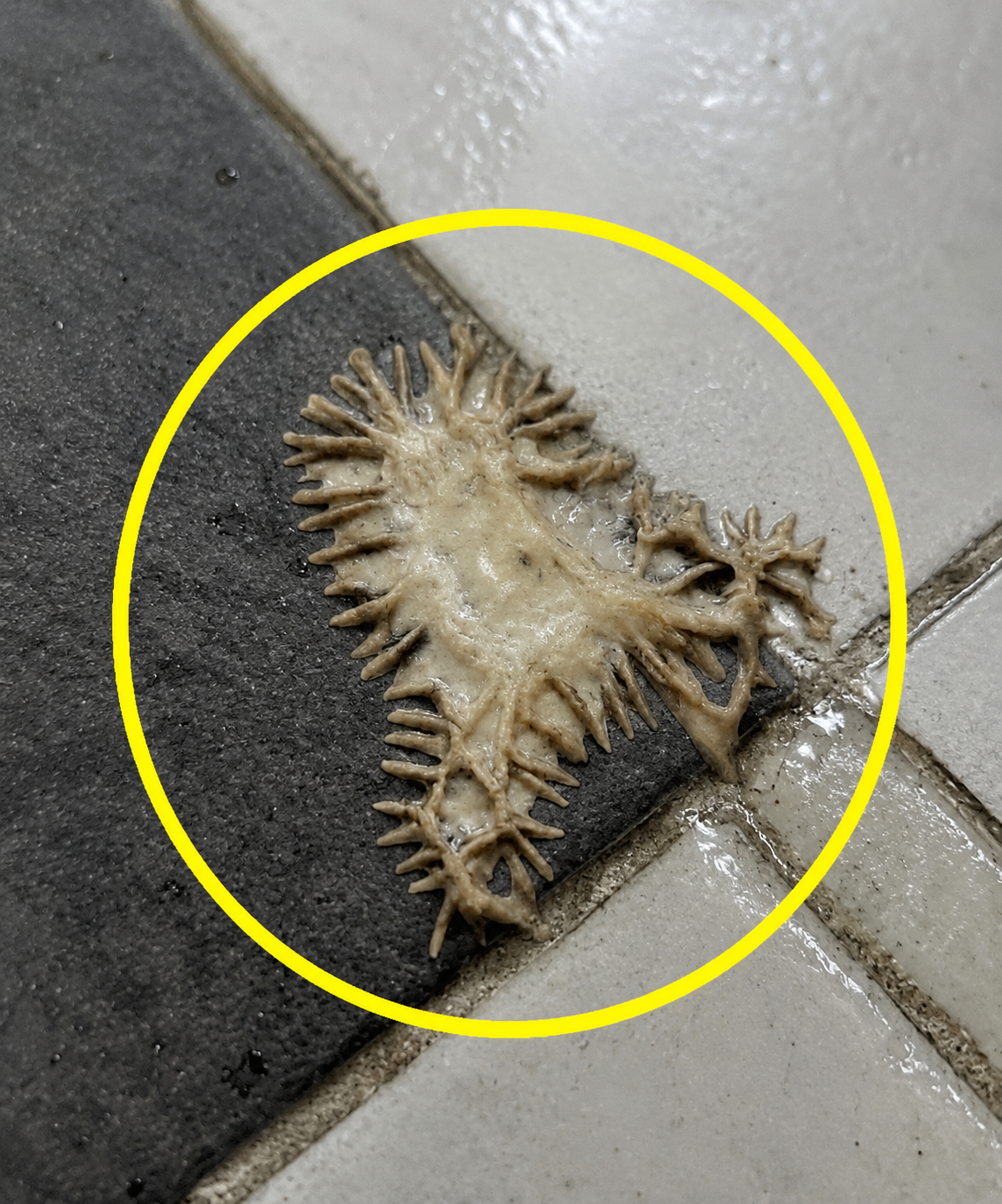
The Strange Organism Found on a Tile Floor: What Could It Be?
Finding an unusual, pale, spiky-looking growth on a bathroom, kitchen, basement, or outdoor tile floor can be startling. At first glance, an object like the one shown in the image may look like an animal, fungus, parasite, or something completely unfamiliar. Its unusual shape, branching structures, and wet appearance naturally make people curious about what they are seeing.
However, photographs alone are often not enough to accurately identify an unusual biological growth. Lighting, moisture, decomposition, and the angle of the photograph can dramatically change how an object looks. The safest approach is to avoid touching it directly and to consider several possible explanations before deciding what it is.
What Does the Object Look Like?
The object appears pale beige or yellowish, with a soft-looking central body surrounded by numerous thin projections. Some projections resemble short spines, while others appear branched or connected to smaller structures. The surface looks moist and somewhat gelatinous.
The object is positioned directly on a tiled surface, close to grout lines where moisture and organic material can accumulate. The surrounding floor also appears damp. These environmental details are important because many microorganisms and decomposing organisms are attracted to consistently wet areas.
The bright yellow circle in the image draws attention to the unusual object, making its shape easier to observe. Even so, the photograph should not be considered definitive evidence of a particular species.
Could It Be a Fungus?
One possibility is that the object is a type of fungal or slime-mold growth. Some slime molds and fungi can develop surprisingly strange shapes, especially when growing on damp organic material.
Slime molds are particularly interesting because some species form irregular networks, blobs, branches, or spore-producing structures. They are not ordinary mushrooms and can appear dramatically different during various stages of their life cycle.
Fungal growth can also develop unusual textures when exposed to water. Instead of producing a familiar mushroom-shaped structure, some fungi appear as mats, threads, patches, or gelatinous masses.
However, the exact identification of the organism cannot be established simply by looking at this photograph. A reliable identification would normally require additional information, including its size, texture, location, environmental conditions, and sometimes microscopic examination.
Could It Be an Animal or Insect?
Another possibility is that the object could be part of a small animal, insect, or other invertebrate that has died and undergone decomposition.
Decomposition can dramatically alter an organism’s appearance. Soft tissues may break down, while harder structures remain visible. Moist environments can accelerate this process and attract microorganisms and scavenging insects.
Some small aquatic or semi-aquatic organisms can also have unusual external structures that look unfamiliar when photographed close-up. Without a scale reference, it can be difficult to determine whether the object is only a few centimeters long or considerably larger.
This is why it is important not to rely on dramatic labels such as “dangerous parasite” or “deadly creature” without scientific evidence.
Why Moisture Matters
The location of the object provides an important clue. Damp tile and grout can create favorable conditions for microorganisms, algae, fungi, and slime molds.
Bathrooms, poorly ventilated rooms, leaking areas, basements, and outdoor spaces can all develop persistent moisture. When water remains in cracks or grout lines, organic debris can accumulate. Dust, skin particles, food residue, plant material, and other organic matter can provide nutrients for microorganisms.
If a strange growth repeatedly appears in the same area, the underlying moisture problem may be more important than the growth itself.
Checking for leaking pipes, damaged grout, poor ventilation, condensation, or standing water can help prevent future growth.
Should You Touch It?
It is best not to handle an unidentified biological growth with bare hands. Most strange growths found in homes are not necessarily dangerous, but there is no reason to take unnecessary risks.
Avoid squeezing, scraping, or breaking the object apart. Disturbing an unknown organism could spread spores, bacteria, or other material onto surrounding surfaces.
If removal is necessary, use appropriate household cleaning practices and protective gloves. Keep children and pets away from the area until it has been cleaned.
People with allergies or respiratory sensitivities should be especially cautious around visible mold or suspected fungal growth.
How to Clean the Area
Before cleaning, remove nearby objects that could become contaminated. Wear disposable gloves and avoid creating unnecessary dust or aerosols.
For ordinary household surface contamination, clean the affected tile and grout according to the manufacturer’s recommendations for the flooring material. A suitable household disinfectant or cleaning product may be used when appropriate, following the product label carefully.
Never mix different cleaning chemicals, particularly products containing bleach with ammonia or acidic cleaners, because dangerous gases can form.
After cleaning, dry the area thoroughly. Improving ventilation can also reduce the chance of microorganisms returning.
If the growth is associated with a leak, simply cleaning the surface may not solve the problem. The moisture source should be repaired.
When Should You Seek Professional Help?
Professional assistance may be appropriate if a strange growth is large, keeps returning, is associated with extensive mold, or appears alongside water damage.
A professional mold-remediation specialist can evaluate persistent moisture and visible fungal growth. If the object appears to be an unusual insect, animal, or other organism, a local pest-control professional or biological identification service may be able to provide a more accurate identification.
For people who want a definite scientific answer, collecting a clear photograph from several angles along with a size measurement can be helpful. In some cases, physical identification requires examination by an experienced specialist.
Avoid Viral Misidentification
Unusual photographs frequently become viral online because they look mysterious or frightening. Social-media posts may describe unfamiliar objects as “alien eggs,” “deadly parasites,” “rare creatures,” or “dangerous infections.”
Such claims should be treated carefully.
A photograph can show what something looks like, but it does not automatically reveal its biological identity. Misidentification can spread quickly when dramatic explanations receive more attention than ordinary scientific possibilities.
A better approach is to describe the visible characteristics objectively: color, shape, size, texture, location, moisture level, and whether the object appears attached to the surface.
The Importance of Scientific Identification
Accurate identification is valuable because different organisms require different approaches. A harmless slime mold does not require the same response as a significant mold infestation or an insect nest.
Scientists and specialists may consider several characteristics when identifying an unknown organism. These can include morphology, habitat, growth pattern, reproductive structures, environmental conditions, and microscopic features.
Modern identification can sometimes involve DNA analysis when conventional observation is insufficient. This demonstrates why a single photograph should rarely be used to make a confident species-level identification.
What You Can Learn From the Image
The most useful lesson from an unusual image like this is that nature can produce remarkably strange forms. Organisms that live in moist environments may develop structures that look completely unfamiliar to the average observer.
The pale color, numerous projections, branching appearance, and wet surroundings make the object visually unusual, but they do not prove that it is poisonous, infectious, parasitic, or dangerous.
Instead of assuming the most frightening explanation, it is better to consider ordinary biological processes first and seek professional identification when necessary.
Final Thoughts
A strange spiky growth on a tiled floor can certainly look alarming, especially when photographed close-up. Nevertheless, unusual appearance does not automatically mean danger. The object shown should not be confidently identified as a specific fungus, parasite, insect, or other organism based solely on the photograph.
The safest response is to avoid direct contact, keep children and pets away, clean the surrounding surface appropriately, and investigate any persistent moisture problem. If the growth returns, spreads, or appears alongside significant water damage, professional assessment may be worthwhile.
Most importantly, avoid sharing unverified claims about mysterious organisms as established facts. A careful description and proper scientific identification are far more useful than a dramatic guess.
The natural world is full of organisms with extraordinary shapes and survival strategies. Sometimes the strangest-looking discovery on an ordinary tile floor is simply a reminder that microscopic and small-scale life can be far more unusual than we expect.